Spray Tips: Right Drop. Right Place. Right Results.
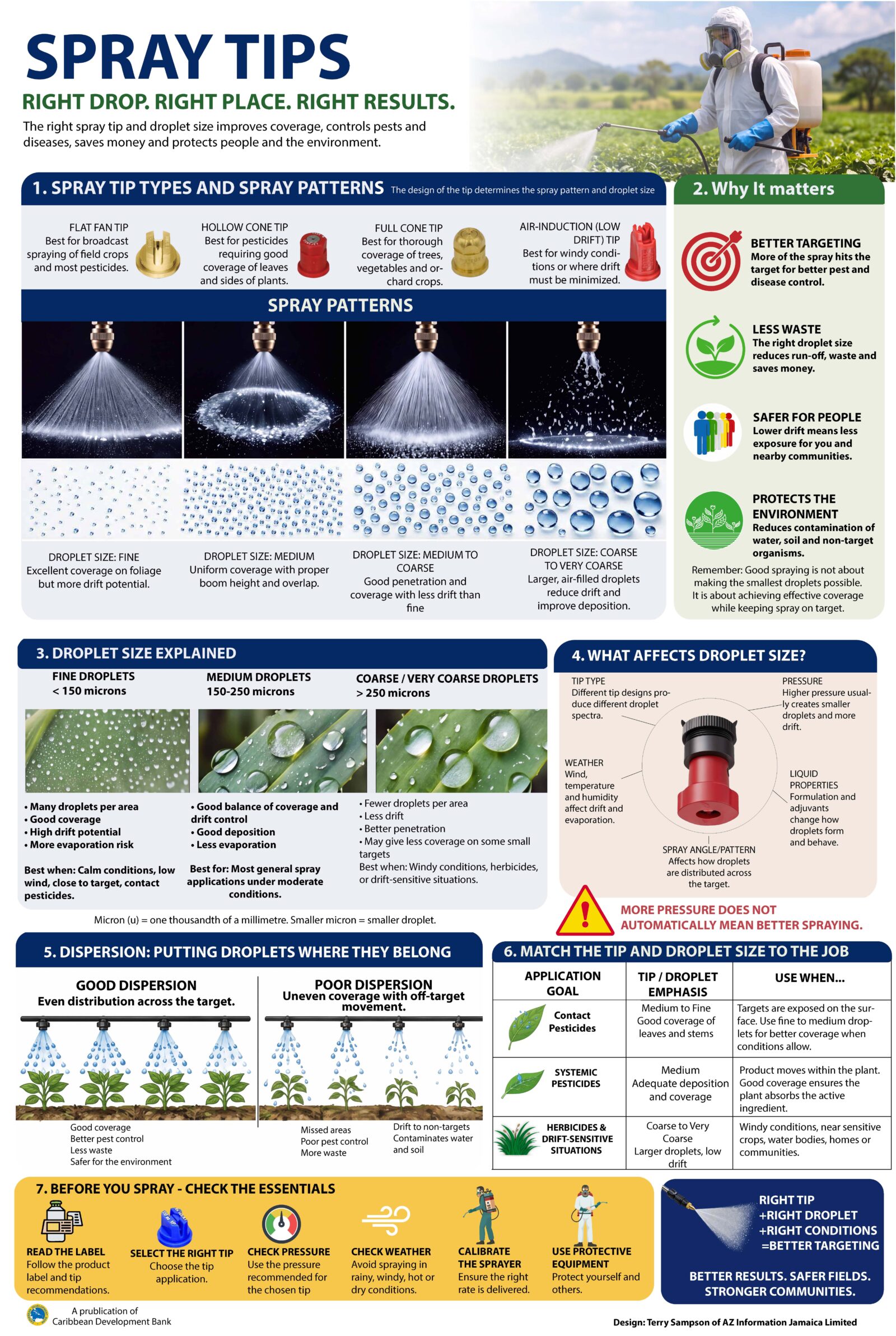
The right spray tip and droplet size can make a significant difference in crop protection. Choosing the appropriate combination improves coverage, enhances pest and disease control, reduces waste, saves money, and helps protect both people and the environment. Effective spraying is not about producing the smallest droplets possible. It is about achieving effective coverage while keeping the spray on target.
Why Spray Tip Selection Matters
The type of spray tip used determines the spray pattern and droplet size produced. Selecting the correct tip helps ensure that products are delivered where they are needed most.
Benefits of proper spray tip selection include:
- Better targeting of pests and diseases.
- Reduced product waste and lower application costs.
- Improved safety for applicators and nearby communities.
- Reduced contamination of water, soil, and non-target organisms.
Understanding Spray Tip Types
Flat Fan Tip
Flat fan tips are best suited for broad, uniform spraying of field crops and many pesticide applications. They provide excellent coverage across a spray boom.
Hollow Cone Tip
Hollow cone tips produce fine droplets and are ideal for applications requiring thorough coverage of leaves and plant surfaces.
Full Cone Tip
Full cone tips deliver thorough coverage and are commonly used in tree crops, vegetables, and orchard systems.
Air-Induction (Low Drift) Tip
Air-induction tips create larger droplets that reduce drift and are especially useful in windy conditions or in areas where drift must be minimized.
Understanding Droplet Size
Fine Droplets (<150 Microns)
Fine droplets provide excellent coverage because more droplets are deposited on the target surface. However, they are more susceptible to drift and evaporation.
Best used when:
- Conditions are calm.
- Wind speeds are low.
- Contact pesticides are being applied.
Medium Droplets (150-250 Microns)
Medium droplets provide a balance between coverage and drift control. They offer good deposition while reducing the risk of spray loss.
Best used for:
- Most general spraying applications.
- Moderate field conditions.
- Situations requiring both coverage and efficiency.
Coarse to Very Coarse Droplets (>250 Microns)
Larger droplets are less prone to drift and evaporation. They penetrate the crop canopy effectively and are useful in drift-sensitive situations.
Best used when:
- Conditions are windy.
- Herbicides are being applied.
- Sensitive crops, water bodies, or communities are nearby.
What Affects Droplet Size?
Several factors influence the size and behaviour of spray droplets:
Spray Tip Design
Different nozzle designs produce different droplet spectra and spray characteristics.
Pressure
Higher spray pressure generally creates smaller droplets, which may increase drift potential. More pressure does not automatically result in better spraying.
Weather Conditions
Wind, temperature, and humidity affect droplet movement, evaporation, and overall spray performance.
Liquid Properties
Product formulations and adjuvants influence how droplets form and behave during application.
Spray Angle and Pattern
The spray pattern determines how droplets are distributed across the target area and affects overall coverage.
Good Dispersion vs Poor Dispersion
Good Dispersion
Even distribution across the target results in:
- Better coverage
- Improved pest and disease control
- Less waste
- Reduced environmental impact
Poor Dispersion
Uneven distribution can result in:
- Missed areas
- Poor pest control
- Increased waste
- Drift onto non-target areas
- Contamination of soil and water
Matching the Tip and Droplet Size to the Job
Contact Pesticides
Use medium to fine droplets to achieve thorough coverage of exposed leaf surfaces and stems.
Systemic Pesticides
Medium droplets typically provide the right balance between coverage and deposition, allowing the product to be absorbed effectively by the plant.
Herbicides and Drift-Sensitive Situations
Use coarse to very coarse droplets to reduce drift and improve application accuracy near sensitive crops, watercourses, homes, or communities.
Before You Spray: Check the Essentials
Before every application:
- Read and follow the product label.
- Select the correct spray tip for the job.
- Use the recommended operating pressure.
- Check weather conditions before spraying.
- Calibrate the sprayer to ensure the correct application rate.
- Wear appropriate personal protective equipment.
Key Takeaway
Right Tip + Right Droplet + Right Conditions = Better Targeting
By selecting the appropriate spray tip, matching droplet size to the application, and spraying under suitable conditions, farmers can achieve better results, reduce waste, improve safety, and protect the environment.





 Shiva DeokiesinghAugust 22, 20262 Mins read







Leave a comment